
Private 2295 John Fletcher Redhead
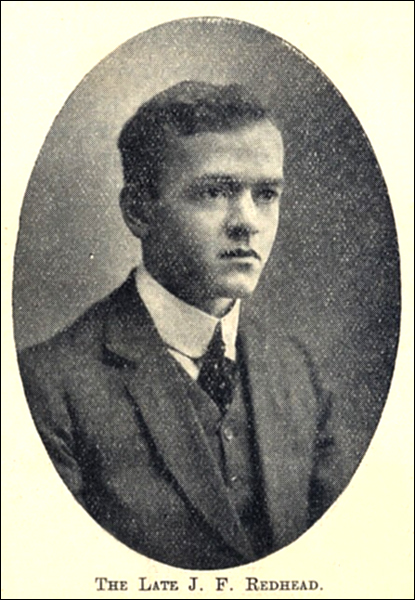
John (known as Jack in the family) probably around 1910. Another photograph at bottom of page.
All photographs courtesy of Jack's great-nephew, David Redhead.
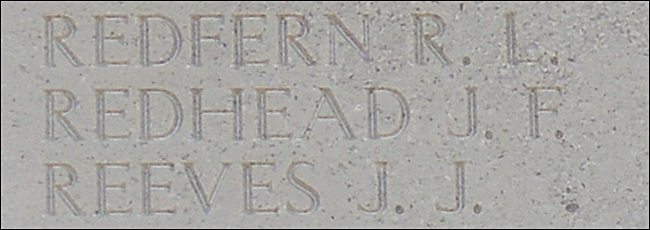
Killed in Action Gallipoli on Saturday, 5th June 1915, age 26.
Commemorated on Panel 158 to 170 of Helles Memorial, Turkey.
1st/6th Bn., Manchester Regiment. 127th Brigade of 42nd Division.
Son of The Reverend John and Mrs Mary Redhead, of 'The Manse'. 49 Sedgley Road, Tipton, Staffs.
Born: Skelmanthorpe, Huddersfield, Enlisted: Manchester, Resident: Tipton.
First landed Balkans, 5th May 1915.
Medal entitlement: 1914-15 Star, British War Medal, Victory Medal.
Soldier's Papers at National Archives did not survive.
Not commemorated on any Tipton memorial, but commemorated on the Elmfield College Memorial, York.
Commemorated here because identified as Tipton on 'Soldiers Died in the Great War'.
Link to Commonwealth War Graves Site: www.cwgc.org/find-war-dead/casualty/687434/
Genealogical Data
Birth of John Fletcher Redhead registered June quarter 1889 in Huddersfield (born on 18 March 1889 at Lodge Villa, Skelmanthorpe, near Huddersfield). Mother's maiden name was Farrow.
1901 Census
23 Trinity Street, Gainsborough, Yorkshire.
John Redhead (48, Primitive Methodist Minister, born Easington), his wife Mary A. (47, born Thornley), and their 4 children: Joseph F. (16, Clerk, born Ventnor), Margaret J. (14, born Ventnor), John F. (12, born Skelmanthorpe), and Thomas J. (8, born Froghall, Staffs).
1911 Census
Monkton House, 18 The Parade, Cardiff, Glamorgan. (A Private School)
Amongst others:
John Fletcher Redhead (22, Single, Schoolmaster, born Skelmanthorpe).
Personal Data
John's father, Rev. John Redhead, was a Primitive Methodist Minister; he was frequently moved between Methodist Circuits around the country. His children were born in various locations, including the Isle of Wight, Norfolk and North Staffordshire; John was born in Skelmanthorpe, near Huddersfield, but lived there only a short time before the family moved on again. At some stage John was a student at Elmfield Methodist College in York as his name is on their War Memorial.
'Soldiers Died in the Great War' shows John being resident in Tipton, and hence why he is commemorated on this web site. This is almost certainly incorrect and that there was confusion post-war when his father, Rev. John Redhead, was living in Tipton between 1918 and 1921. This is certainly the Redhead family view, who believe it unlikely he ever set foot in Tipton. In 1911 he was teaching at Monkton House, a private school in Cardiff, and the Redhead family source reports that he was still a school master in Cardiff when war broke out in August 1914. Biographical details of Rev. John Redhead provided by his great-grandson show that he was a Primitive Methodist Minister in Tipton from 1918 to 1921, living at 49 Sedgley Road West, Tipton ('The Manse').
After John's death, his outstanding army pay and allowances amounted to £7/10/5d (7 pounds, 10 shillings and 5 pence); this was paid to his father, Rev John Redhead in July 1916 . His War Gratuity was £3/0/0d (3 pounds exactly), this was also paid to his father in October 1919. The value of the War Gratuity suggests that John had enlisted within the previous 12 months.
John's father, Rev John Redhead, was awarded a Dependant's Pension of 5/0d (5 shillings eactly) per week, effective from 8th February 1919. His initial address was The Manse, Sedgley Road West, Tipton; and changed to 6 Colgrave Street, Lincoln. This pension transferred to John's mother, Mrs Mary Ann Redhead In February 1926 on the death of her husband.
Action resulting in his death
John Redhead's great-nephew says that at the outbreak of war, John (known as Jack) was still a school master in Cardiff. His brother, Thomas, was already a Territorial with the Manchester Regiment and because of this Jack was also allowed to join the 6th (Territorial) battalion. Despite him having no prior military experience and very little training, he was with the battalion when they left British shores in September 1914.
The 1/6th battalion was mobilised immediately on the declaration of war. In late September 1914 they landed in Egypt where they remained until 3rd May 1915 when they departed for Gallipoli.
On 6th May, they landed at Cape Helles - the location of the initial Gallipoli landings just 2 weeks earlier, on 25th April. The Allies still held just the foot of the Gallipoli peninsula and the 6th Manchesters were soon at the front line, less than 3 miles from Cape Helles, in front of the village of Krithia. Krithia, lying on the lower slopes of Achi Baba, dominated the exits from the Allied beachhead at Cape Helles and was repeatedly attacked but never taken. Here, on 4th June, the Redhead brothers would take part in the 3rd Battle of Krithia.
At 12.00hrs on 4th June, the leading platoons of Manchesters charged across the 200 yards of No Man's Land to be hit by devastating rifle and machine gun fire. Within 5 minutes, they were in the Turkish front line and engaged in fierce hand-to-hand fighting. As they secured the trench, the other platoons of the 6th Manchesters leap-frogged them to take the Turkish support trench.
Attacks on the flanks of the Manchesters had been less successful, and the Turks were now in front and on both flanks. It was impossible to hold the position, and at 18.30hrs an order was given to withdraw back to the original Turkish front line – the first objective for the day. Losses had been severe, and the new line was held overnight by just 150 men and a single officer; 770 men gone into action that morning.
According to the records of the Commonwealth War Graves Commission (CWGC), the battalion had 63 men killed on the 4th June. The CWGC shows that the battalion had even heavier losses on the 5th June when holding the line, with 81 men killed including John Redhead. This is unlikely to be accurate, and John Hartley, in his book "Not A Rotter in the Lot", believes that the majority of deaths would have been on 4th June. It is therefore likely (but not definitive) that John Redhead was killed on the 4th June.
Jack's brother, Thomas, was wounded on the same day, and had to be evacuated back to Malta for medical treatment. Thomas was later commissioned and ended the war with the rank of Captain, and was awarded the Military Cross and Bar (meaning he won the MC twice).
Like most men killed at the 3rd Battle of Krithia, John has no known grave and is commemorated on the Helles Memorial.
Newspaper Cuttings
Following is courtesy of: www.myprimitivemethodists.org.uk/content/subjects-2/first_world_war/armed-forces/john_fletcher_redhead
Gainsborough News 16th April 1915
Private J.F. Redhead and Private T.J. Redhead, both sons of the Rev. J. Redhead, write some interesting letters from Egypt. A visit to Memphis is described, and the enormous statues to be seen there, almost in perfect condition thanks to the dry atmosphere. The Pyramids and the Sphinx have claimed a great share of attention, and how observant our soldiers are is shown by the description, and diagrams illustrating how the work of irrigation cuts a clear line between the untamed desert and smiling fields. The system of irrigation is also described in most interesting fashion, and what is better still, illustrated by drawings.
Flies are still one of the plagues of Egypt, and the plaintive question is asked, “Do you know anything we can wash with to keep flies off, besides the usual recipe of treacle and boiled oil? Carbolic they seem to like. Many of us have muslin netting to keep them off, and almost everybody has a fly whisk. They are a terrible nuisance.” We should have thought treacle would have been an attractor rather than a deterrent. The insect pests notwithstanding the troops appear to be having a real good time in the land of the Pharaohs. It is indeed a wonderland to them, but our friends are apparently anxious to get along to Constantinople as one of them remarks, “Then Germany will indeed be near the end.”
Primitive Methodist Leader, June 1915.
Rev. J. Redhead’s son killed.
The “Primitive Methodist Leader” announces that Private John Fletcher Redhead (26), son of the Rev. J. Redhead, Primitive Methodist minister, Sheffield, and formerly of Gainsborough, reported as missing is now officially returned as killed on June 4th in the Dardanelles- “a sacrifice on the altar of liberty and humanity.”
When at Gainsborough Private Redhead won a County Council Scholarship, and took three scholarships in his stay at Elmfield. He was preparing for his final examination for B.A. when he enlisted. He was killed in a bayonet charge. His brother went into action alongside him, and writes home:-
“We got the order to charge and fixed bayonets. Jack (the deceased) and I shook hands and away we went over the parapet. The Turks had well-concealed guns and lots of our chaps went over like skittles. After the guns were silenced, we rallied and once the Turks were on the run it was like “ratting.” I never saw Jack again”.
The writer was wounded and wrote from hospital. Two other brothers are also in the Army.
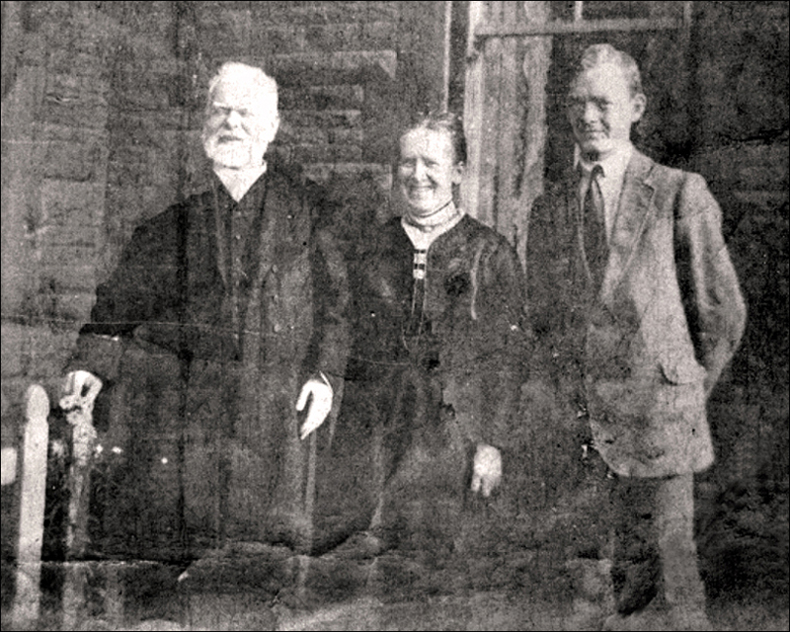
Jack on right with his father and mother, Reverend John and Mrs Mary Redhead. Believed to be taken in 1913.